Zoning & Planning
Legal Rights Against Unlicensed Construction and Demolition Orders
What counts as an unlicensed building under Article 32 of Zoning Law No. 3194, the construction stop report, the one-month period, how demolition orders are made and how to challenge them within 60 days.

This article is an English translation of the Turkish original published by the office.
Zoning law is the branch of law that aims to ensure that settlements are planned, organised and built in accordance with legal rules. One of its most important aims is to prevent unlicensed construction and so maintain order in living spaces. In this article we discuss unlicensed construction — and the rights that may be available, in some cases, against decisions concerning it.
What is an unlicensed building?
Under Article 20 of the Zoning Law No. 3194, a building may be constructed only on land, plots or parcels for which the institution or person holds a title deed — or, without a title deed, on the basis of allocation or easement documents issued by public bodies — and in accordance with the zoning plan, regulations, the building permit and its annexes.
An unlicensed (kaçak) building is one constructed without a building permit or contrary to the permit obtained. Under Article 32 of Law No. 3194, buildings constructed without a permit or contrary to the permit and its annexes are treated as unlicensed. Construction started without the necessary permit from the relevant authority (the municipality or the special provincial administration), and buildings that do not comply with the permit and its annexes or exceed the limits it sets, therefore fall into this category.
How are unlicensed buildings identified?
Unlicensed buildings are usually identified after a report. Citizens may notify the municipality or special provincial administration, and under Article 32 of the Zoning Law municipalities are obliged to prevent and demolish unlicensed buildings. Teams receiving a report go to the address, carry out the necessary inspection and, if the building breaches the Zoning Law, start the legal process — which may lead to the work being stopped and to demolition.
What is a construction stop report?
Under Article 32 of Law No. 3194, when unlicensed construction is identified, the current state of the construction is first recorded and the site is sealed. The report drawn up at that point is called the construction stop report (yapı tatil tutanağı). Article 4 of the Planned Areas Zoning Regulation defines it as the approved document, prepared by technical staff authorised by the relevant authority, which records the current state of the building and its breaches in pictures, sketches and writing where construction was started without a permit or a permitted building breaches the permit and its annexes, and which shows that construction may not continue.
Article 32 provides that, at the end of a period of at most one month from the sealing and stopping of the construction, a demolition decision may be taken for buildings for which no permit has been obtained or whose breach of the permit has not been remedied.
The right to challenge a construction stop report
A construction stop report is itself an administrative act, so an annulment action may be filed against it at the administrative court, together with a request for a stay of execution where the conditions are met. The competent court is the administrative court of the place where the building is located; if there is no administrative court in that province, the case is filed at the administrative court with jurisdiction over it.
The demolition decision
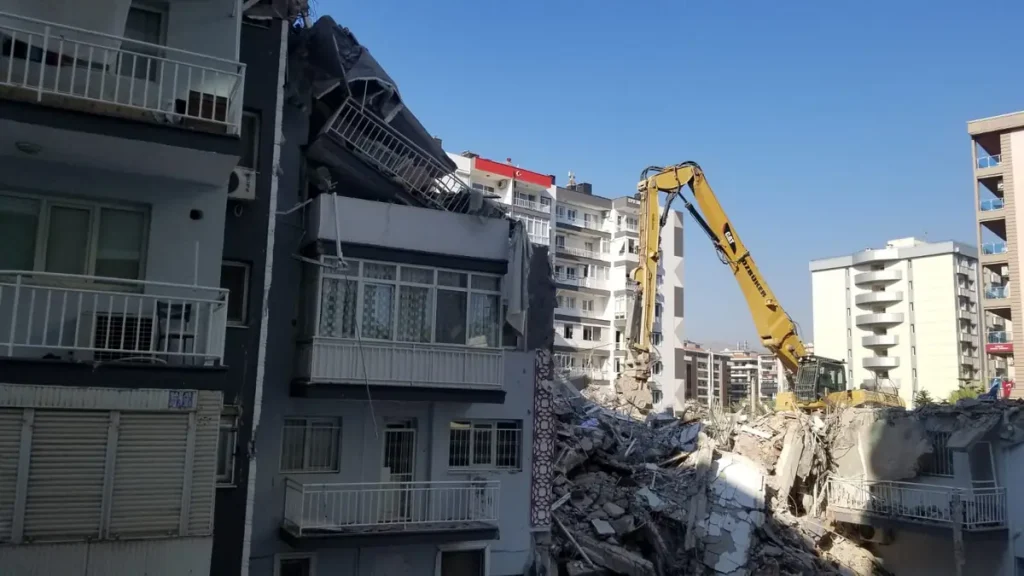
A demolition decision for an unlicensed building is taken under Article 32 of Law No. 3194 following a set procedure:
- Identification and construction stop report: unlicensed buildings or those breaching the permit and its annexes are identified through inspections by the relevant authority or citizens’ complaints. A construction stop report is drawn up, the building is sealed and work is stopped. The report sets out how the building breaches zoning legislation.
- Notification and time limit: Article 32 provides that the construction stop report is deemed served on the owner when it is posted at the site. Posting the report on the building is considered sufficient to notify the owner of the breaches, and leaving a copy with the neighbourhood headman is not required for valid notification. The owner is given at most 30 days to remedy the breach. The one-month period to obtain a permit or remedy the breach is an upper limit; a shorter period may be given in the report or by a separate act. If the owner does not remedy the breach within the period, the authority takes a demolition decision. If no period is given in the report or separately, the owner is deemed to have been given one month from the date of the report, and a demolition decision taken before that period expires is unlawful.
- The demolition decision: if the breach continues at the end of the period, the municipal council committee or the provincial council committee decides on demolition. The decision is notified to the owner and the building is demolished. Demolition costs are collected from the owner.
Objections and annulment actions against demolition decisions
The following remedies are available against demolition decisions for unlicensed buildings:
- Application to the administration: within 60 days of notification of the demolition decision, the owner may apply to the authority that made it under Article 11 of the Administrative Procedure Law, asking for the decision to be withdrawn. If the authority does not respond within 30 days, the request is deemed implicitly rejected and the filing period resumes where it left off. This application is not mandatory; a case may be filed directly, as below.
- Annulment action: an annulment action may be filed at the administrative court within 60 days of notification of the demolition decision, arguing that the decision is unlawful and should be annulled. A stay of execution may be requested when filing so that demolition is postponed during the proceedings.
- Request for a stay of execution: when filing the annulment action, the court may be asked to suspend the demolition until the case is concluded. The court examines whether the act is clearly unlawful and whether damage would arise that is difficult or impossible to remedy.
Because demolition decisions directly affect property rights, it is important to follow the legal process carefully and seek support from an experienced lawyer when needed.
Türker Law Office provides legal representation and advice on construction stop reports, sealing, demolition decisions concerning buildings constructed without a permit or contrary to a permit and its annexes, and on administrative applications, annulment and stay-of-execution actions against them.
This article is for general information and reflects the legislation in force on its publication date. Every case is different; please obtain legal advice on your specific situation.